My bookshelves veer wildly between the respectable and the ridiculous. The historical aristocracy sits upstairs, while down in the basement lurks a spectacularly unfortunate 1930 boys’ book called Scouts in Bondage by Geoffrey Prout. It sits innocently on the shelf—a battered hardback that has survived more house moves than any sensible person would admit—and it still routinely makes visitors choke on their tea.
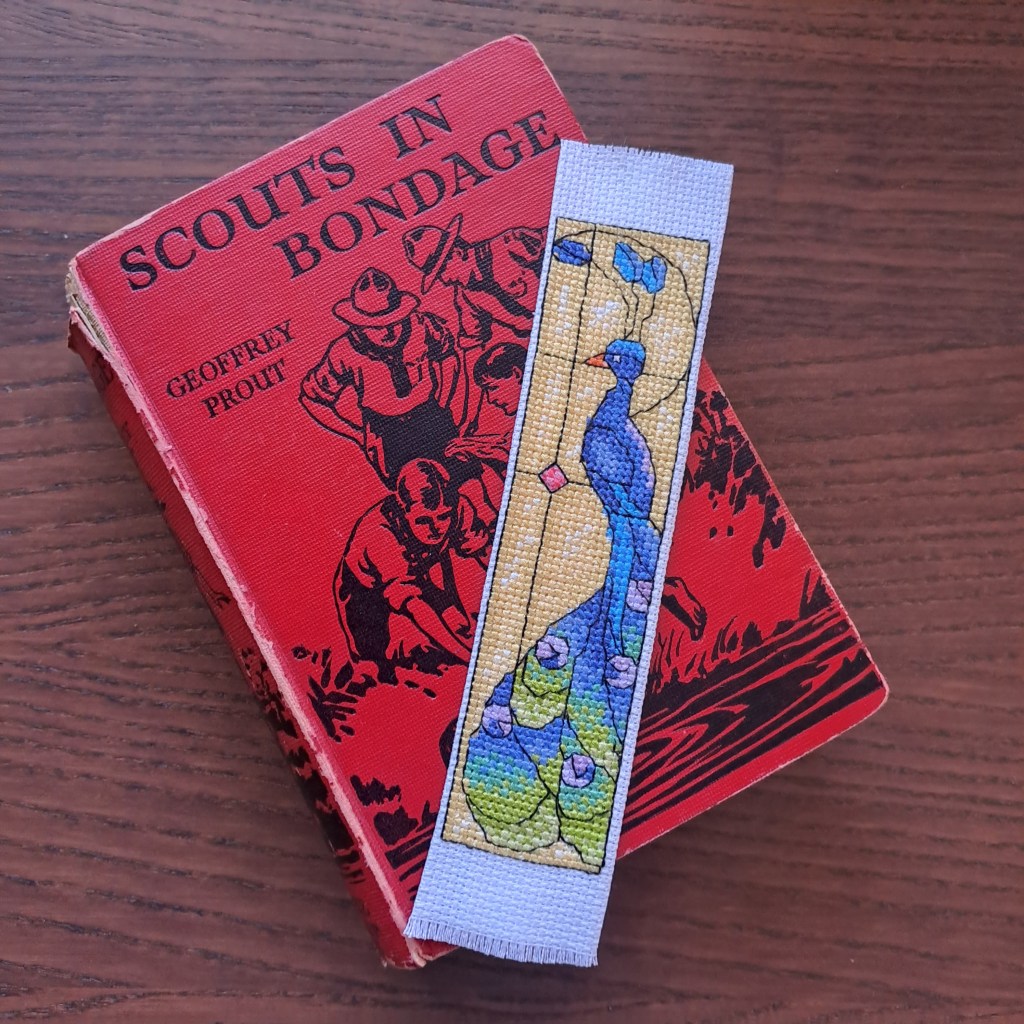
To make matters worse, Mr. Prout’s other famous literary contribution is a book called Trawler Boy Dick. You truly cannot script this level of accidental filth.
Recently, while reading Agatha Christie’s 1920 murder mystery The Mysterious Affair at Styles, I stumbled across a line where the narrator notes that a gentleman “stood abstractedly fingering the ornaments.” Instantly, my inner twelve-year-old giggled. It made me wonder: is this reflex just a personal maturity flaw, a uniquely British affliction, or does it actually have some genuine value for the queer reader?
To be fair to the dead, we aren’t actually misreading these vintage texts; we are looking at them through the warped lens of modern slang. Words shift, innocence curtsies into innuendo, and a neutral verb from a century ago accidentally becomes a massive wink across time.
When Christie wrote her line in 1920, she merely meant Captain Hastings was nervously touching the knick-knacks on the mantelpiece. Today, “fingering” and “ornaments” carry heavily sexualized anatomical connotations. Similarly, when the real-life Geoffrey Prout—a decorated World War I veteran and earnest English boat builder—penned Scouts in Bondage, he was using “bondage” in the old-fashioned sense of a binding legal obligation. The actual plot involves a troop of wholesome Boy Scouts tied to a business deal to dig up a chapel for a professor.
Prout’s book is so famous for this semantic drift that it routinely tops lists of the most unintentionally hilarious book titles in British history, comfortably sitting alongside other adventure stories like Drummer Dick’s Discharge by Beatrix M De Burgh, academic medical texts like The Resistance of Piles to Penetration by Russell V. Allin and instruction manuals such as Single Handed Cruising by Francis B. Cooke, sometimes accompanied by The Danger of Cruising by Charles Sutton. We can only assume that he must have known.
But Scouts in Bondage also belongs to a wider comedic phenomenon where the innocent language of gentler ages acquires ‘nudge-nudge, wink-wink’ overtones over time. We see this linguistic divide clearly when American titles cross the Atlantic; Troy Hitch’s Night of the Willies (meant to soothe a child’s fear of the dark) or Jack Vance’s 1969 sci-fi novel Servants of the Wankh both provoked such relentless schoolyard giggles from British readers that Vance’s publishers eventually had to rename the alien race to “Wannek.” Furthermore, the title of the novel and Netflix film Our Souls at Night didn’t work in the U.K. because, when spoken aloud in many British accents, it sounds like ‘arseholes at night’.
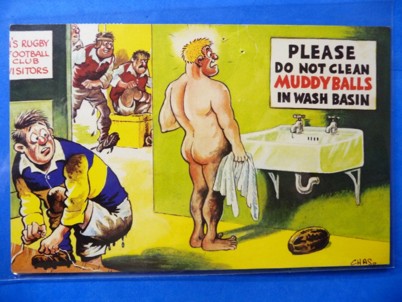
Is the joy of this purely an English thing? Highly likely. The specific flavour of giggling at unintended filth is deeply rooted in the British ‘saucy seaside postcard’ tradition (see example below). For the uninitiated outside the UK, British humour has historically operated on a single, glorious rule: take something completely innocent, find the naughty second meaning, and then play the national sport of desperately pretending not to notice the thing everyone in the room has clearly noticed. These postcards were traditionally aggressively heterosexual, making the modern queer appropriation of that exact same ‘nudge-nudge’ humour a delicious irony.
When we read British authors of the 1920s and 30s, we are playing right in the delivery room of the modern double entendre. The humour comes entirely from the grand, hysterical canyon between how desperately earnest the author was, and how thoroughly ruined our modern minds are.
But for the queer reader, this reflex goes far deeper than a childish chuckle. The humour lives exactly where queer reading has always lived: in the margins of language, hearing the unsaid, the unintended, and the accidental resonance.
For generations, queer people had to become expert code-breakers. We were trained to read sideways. We had to notice tone, implication, and gaps because the straight world’s primary meaning was never meant to include us in the first place. For decades, being open was illegal or dangerous, so looking for alternative, hidden meanings in mainstream texts was a literal survival strategy.
Long before many of us had ever heard of formal queer theory, we had this muscle memory of marginal reading. In the UK, a generation grew up listening to Julian and Sandy on BBC radio—two camp characters who smuggled Polari (an underground queer slang used by gay men, theatrical performers, and seafarers to communicate safely in public) into mainstream teatime broadcasts. They ran absurd fictional businesses like Bona Drag (good clothes) or a Private Detective Agency delivered with limp-wristed flair. The joke was never the flimsy business itself; it was the way the straight host blundered into double meanings he pretended not to see.
Even the word ‘queer’ itself mirrors this evolution. Throughout The Mysterious Affair at Styles, upper-class characters constantly remark, “It’s very queer,” simply meaning strange. The trajectory of that single word perfectly tracks how language betrays, preserves, and rewrites its own history.
There is immense, joyful utility in reading old books with a modern mind. It grants us a sort of linguistic time-travel superpower. We get to appreciate the innocence of the past while simultaneously bringing our modern, sex-positive, queer joy to the table. By taking rigid, old-fashioned, highly disciplined mid-century structures—whether it’s Agatha Christie’s upper-class manors or Geoffrey Prout’s wholesome, knot-tying Boy Scouts—and completely subverting them with a modern queer gaze, we reclaim the narrative.
It turns out my inner twelve-year-old wasn’t just being immature. He was flexing the very same tool that taught a generation how to decode subtext, survive the straight world, and laugh in code.
Listen: Take a trip back to the BBC light entertainment airwaves with the masters of the mainstream double entendre: [Bona Male Models – Julian and Sandy (YouTube Link)]. Originally broadcast on Round The Horne, March 24th 1968
 Queer After Everything