The Retroactive Double Entendre: A Guide to Reading Sideways

My bookshelves veer wildly between the respectable and the ridiculous. The historical aristocracy sits upstairs, while down in the basement lurks a spectacularly unfortunate 1930 boys’ book called Scouts in Bondage by Geoffrey Prout. It sits innocently on the shelf—a battered hardback that has survived more house moves than any sensible person would admit—and it still routinely makes visitors choke on their tea.
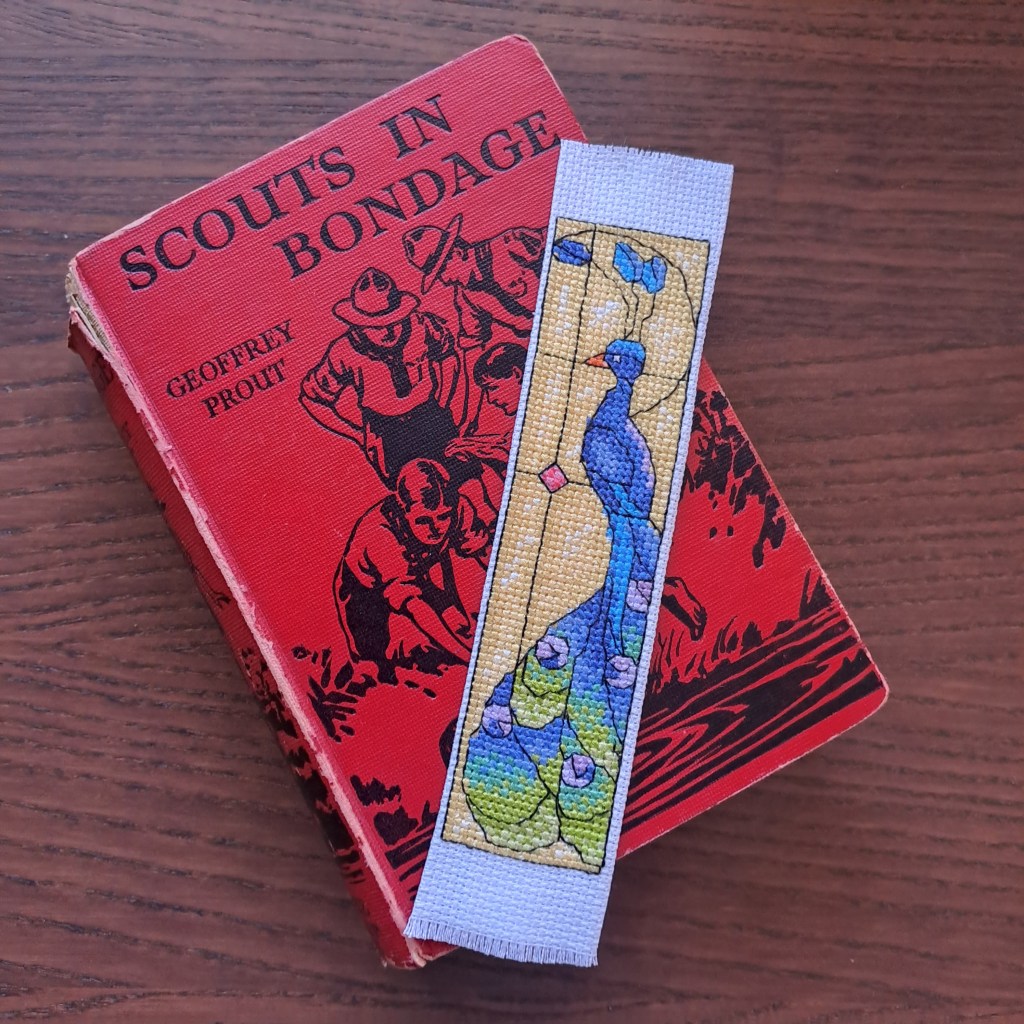
To make matters worse, Mr. Prout’s other famous literary contribution is a book called Trawler Boy Dick. You truly cannot script this level of accidental filth.

Recently, while reading Agatha Christie’s 1920 murder mystery The Mysterious Affair at Styles, I stumbled across a line where the narrator notes that a gentleman “stood abstractedly fingering the ornaments.” Instantly, my inner twelve-year-old giggled.  It made me wonder: is this reflex just a personal maturity flaw, a uniquely British affliction, or does it actually have some genuine value for the queer reader?

To be fair to the dead, we aren’t actually misreading these vintage texts; we are looking at them through the warped lens of modern slang. Words shift, innocence curtsies into innuendo, and a neutral verb from a century ago accidentally becomes a massive wink across time.

When Christie wrote her line in 1920, she merely meant Captain Hastings was nervously touching the knick-knacks on the mantelpiece. Today, “fingering” and “ornaments” carry heavily sexualized anatomical connotations.  Similarly, when the real-life Geoffrey Prout—a decorated World War I veteran and earnest English boat builder—penned Scouts in Bondage, he was using “bondage” in the old-fashioned sense of a binding legal obligation. The actual plot involves a troop of wholesome Boy Scouts tied to a business deal to dig up a chapel for a professor.

Prout’s book is so famous for this semantic drift that it routinely tops lists of the most unintentionally hilarious book titles in British history, comfortably sitting alongside other adventure stories like Drummer Dick’s Discharge by Beatrix M De Burgh, academic medical texts like The Resistance of Piles to Penetration  by Russell V. Allin and instruction manuals such as Single Handed Cruising by Francis B. Cooke, sometimes accompanied by The Danger of Cruising by Charles Sutton. We can only assume that he must have known.

But Scouts in Bondage also belongs to a wider comedic phenomenon where the innocent language of gentler ages acquires ‘nudge-nudge, wink-wink’ overtones over time. We see this linguistic divide clearly when American titles cross the Atlantic; Troy Hitch’s Night of the Willies (meant to soothe a child’s fear of the dark) or Jack Vance’s 1969 sci-fi novel Servants of the Wankh both provoked such relentless schoolyard giggles from British readers that Vance’s publishers eventually had to rename the alien race to “Wannek.” Furthermore, the title of the novel and Netflix film Our Souls at Night didn’t work in the U.K. because, when spoken aloud in many British accents, it sounds like ‘arseholes at night’.

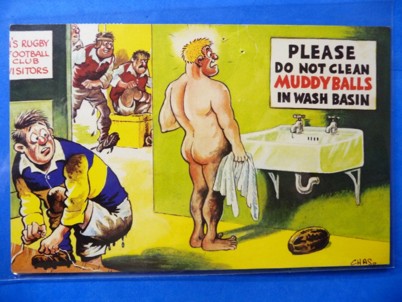
Is the joy of this purely an English thing? Highly likely. The specific flavour of giggling at unintended filth is deeply rooted in the British ‘saucy seaside postcard’ tradition (see example below).  For the uninitiated outside the UK, British humour has historically operated on a single, glorious rule: take something completely innocent, find the naughty second meaning, and then play the national sport of desperately pretending not to notice the thing everyone in the room has clearly noticed.  These postcards were traditionally aggressively heterosexual, making the modern queer appropriation of that exact same ‘nudge-nudge’ humour a delicious irony.

When we read British authors of the 1920s and 30s, we are playing right in the delivery room of the modern double entendre. The humour comes entirely from the grand, hysterical canyon between how desperately earnest the author was, and how thoroughly ruined our modern minds are.

But for the queer reader, this reflex goes far deeper than a childish chuckle. The humour lives exactly where queer reading has always lived: in the margins of language, hearing the unsaid, the unintended, and the accidental resonance.

For generations, queer people had to become expert code-breakers. We were trained to read sideways. We had to notice tone, implication, and gaps because the straight world’s primary meaning was never meant to include us in the first place. For decades, being open was illegal or dangerous, so looking for alternative, hidden meanings in mainstream texts was a literal survival strategy.

Long before many of us had ever heard of formal queer theory, we had this muscle memory of marginal reading. In the UK, a generation grew up listening to Julian and Sandy on BBC radio—two camp characters who smuggled Polari (an underground queer slang used by gay men, theatrical performers, and seafarers to communicate safely in public) into mainstream teatime broadcasts. They ran absurd fictional businesses like Bona Drag (good clothes) or a Private Detective Agency delivered with limp-wristed flair. The joke was never the flimsy business itself; it was the way the straight host blundered into double meanings he pretended not to see.

Even the word ‘queer’ itself mirrors this evolution. Throughout The Mysterious Affair at Styles, upper-class characters constantly remark, “It’s very queer,” simply meaning strange. The trajectory of that single word perfectly tracks how language betrays, preserves, and rewrites its own history.

There is immense, joyful utility in reading old books with a modern mind. It grants us a sort of linguistic time-travel superpower. We get to appreciate the innocence of the past while simultaneously bringing our modern, sex-positive, queer joy to the table.  By taking rigid, old-fashioned, highly disciplined mid-century structures—whether it’s Agatha Christie’s upper-class manors or Geoffrey Prout’s wholesome, knot-tying Boy Scouts—and completely subverting them with a modern queer gaze, we reclaim the narrative.

It turns out my inner twelve-year-old wasn’t just being immature. He was flexing the very same tool that taught a generation how to decode subtext, survive the straight world, and laugh in code. 
From Scouts in Bondage to accidental filth in Agatha Christie, here is why giggling at vintage double entendres is actually a brilliant queer superpower.

Listen: Take a trip back to the BBC light entertainment airwaves with the masters of the mainstream double entendre: [Bona Male Models – Julian and Sandy (YouTube Link)]. Originally broadcast on Round The Horne, March 24th 1968
Starry Night, Slowed Down

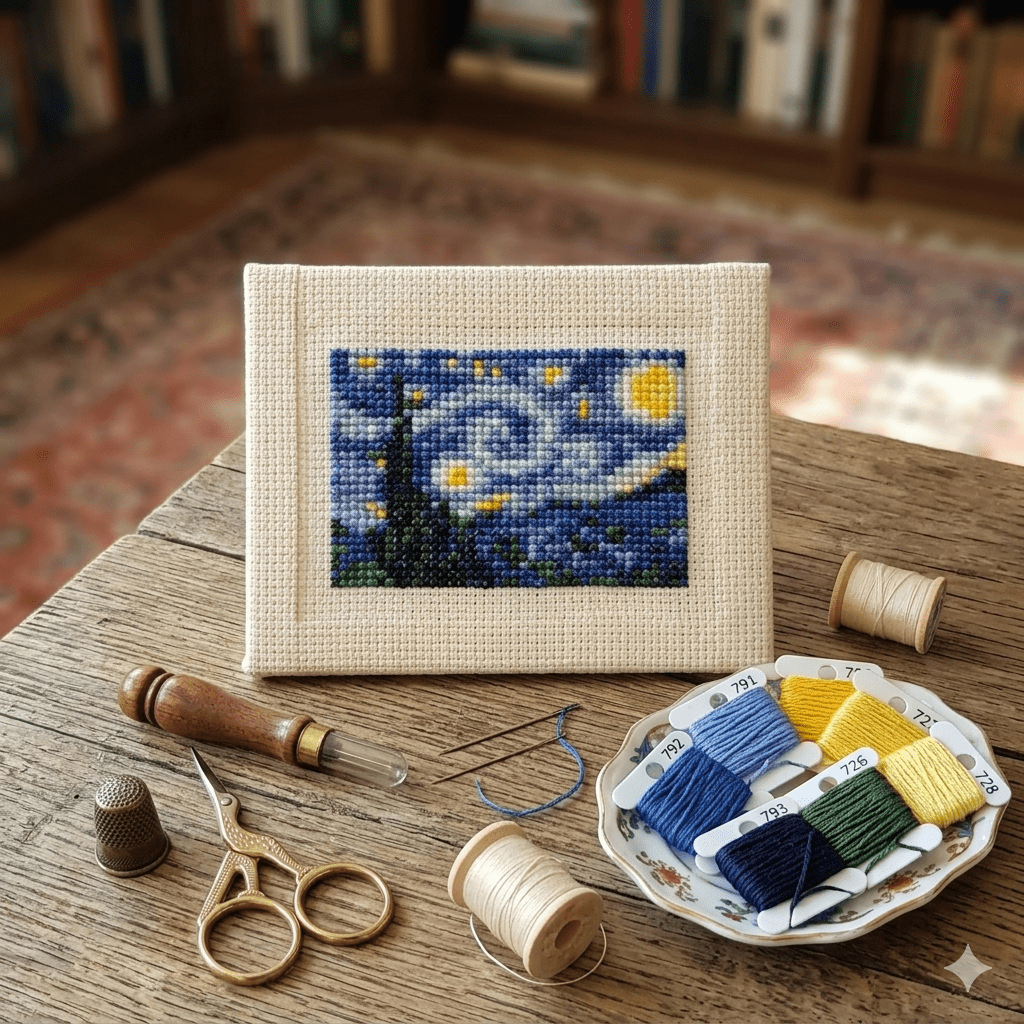
Some images refuse to stay in museums. They slip into living rooms, onto mugs, into cross‑stitch patterns, and onto the quiet surfaces of kitchen tables. Van Gogh’s sky – once a storm of paint and urgency – becomes something smaller and steadier when translated into thread. The turbulence softens. The night becomes patient. A masterpiece becomes a domestic object, stitched slowly in the pauses of a day.

On the table, my embroidery gathers its own weather. Scissors, a thimble, numbered skeins of blue and yellow – they orbit the little canvas like minor moons. The whole thing looks less like a craft project and more like a still life that’s been caught mid‑breath. A famous sky, reduced to a handful of stitches, sits there as if it has always belonged among the bookshelves and the patterned rug. As if the cosmos has agreed, just this once, to come indoors and behave itself.

Thread doesn’t copy a painting; it translates it. Every stitch is a decision about what to keep, what to simplify, what to let go. Van Gogh’s spirals – made in a fever of colour and memory – settle into neat squares of Ultramarine and Cadmium yellow. The cypress, once a dark flame licking at the sky, becomes a softened silhouette. The stars glow without shouting. Turbulence becomes tactility. The night becomes something you can hold in your hand.

It’s strange, the way certain images follow you through a life. Starry Night was once the sort of thing I saw on posters in student flats, or on the walls of bars where the jukebox played Don McLean and everyone pretended not to be heartbroken. Later, it turned up in unexpected places – on tea towels, in museum gift shops, in the background of conversations I barely remember. And now here it is again, stitched into fabric on a table in a quiet Dutch room, as if it has been waiting for this moment of domestic calm.

Maybe that’s what happens with the things we think we know. They return in altered forms. They ask to be looked at again. They become gentler with age – or perhaps we do.

Van Gogh painted his sky from memory, a view out of an asylum window at a world he wasn’t quite part of. I understand that more than I’d like to admit. I doubt he imagined it would one day be recreated in thread by people who find solace in the slow, repetitive work of making. There’s something comforting in the idea that a painting born of restlessness can end up as a small, steady object on a table – a reminder that even the wildest nights can be translated into something gentler with enough time and enough thread. Turbulence doesn’t last forever, but the marks it leaves can still be beautiful.

On the table, the stitched sky waits. The tools rest. The room holds its breath. And in the quiet, the night becomes something else entirely – not a masterpiece, not a symbol, not a cultural shorthand, but a small, steady reminder that even the wildest storms can be softened by time, by labour, by the simple act of making something with your hands.

A slow, starry night, after everything.

Queer? What? Why now?

When the original UK television series of Queer as Folk launched in 1999 it felt like a messy revolution. I was already done with the gay commercial scene by 1999 (or so I thought, but that’s another story) but Queer as Folk resonated in several opposing ways.

The scene of my adolescence was a northern English industrial town, surrounded by steelworks, the sky lighting up red as the slag was tipped, the sirens sounding across the town when the worker’s shifts changed. There’s a saying up there, dating back hundreds of years: ‘There’s nowt so queer as folk.’ Which translates roughly into ‘There’s nothing as strange as people.’ People would tut and roll their eyes at some perceived misdemeanour and smile and say ‘There’s nowt so queer as folk.’

But then queer was used in other contexts. It was a hissed word in school corridors, a warning, a way of being told what I was before I knew it myself. A warning to keep out of the way. There was nowt so queer as me.

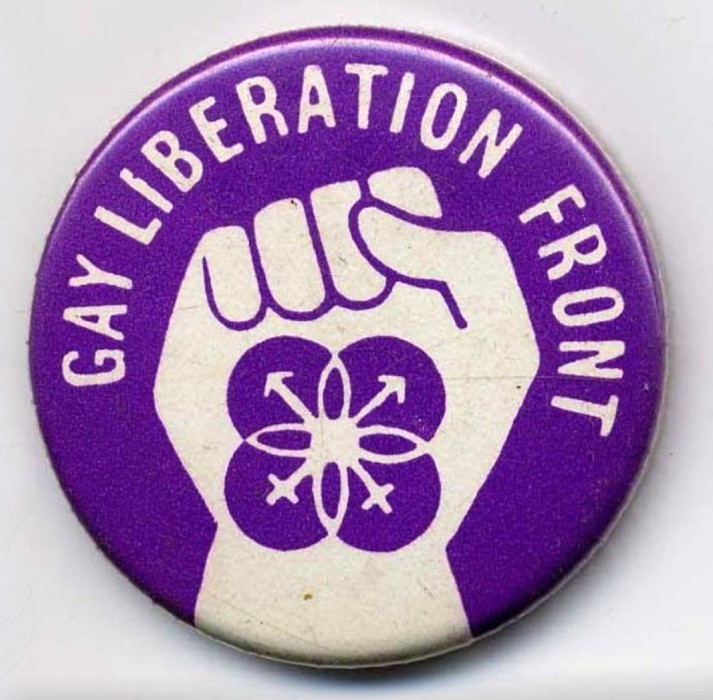
I did get out of the way and like hundreds if not thousands of provincial gay boys rejected from their families I got to London and started building a life at age 15 with an illegal sexuality. I marched with the Gay Liberation Front wearing the infamous purple fist badge in the early 70s and learned to accept myself as ‘Gay’. I’d only ever heard ‘Queer’ – never as identity, always as insult.

And even on those Gay Liberation Front marches we heard it again from spitting onlookers ‘Dirty Queer’. We tried to tell ourselves that ‘Gay’ stood for ‘Good As You’. It was the kind of slogan we repeated until we almost believed it. I’d only ever heard ‘gay’ in the context of Bright Young Things in the 1920s and though I was having a gay old time it wasn’t all costume parties and champagne.

Queer as Folk gave a narrow, sex‑heavy, issue‑light portrayal of gay life, foregrounding club culture, casual sex and hedonism. I didn’t associate with that either.

Years later, I was still having problems associated with being queer. I thought queers had to look queer, behave in a queer way, and in fact I was looking at queerdom in exactly the same way the uninformed looked at homosexuality in the 70s.

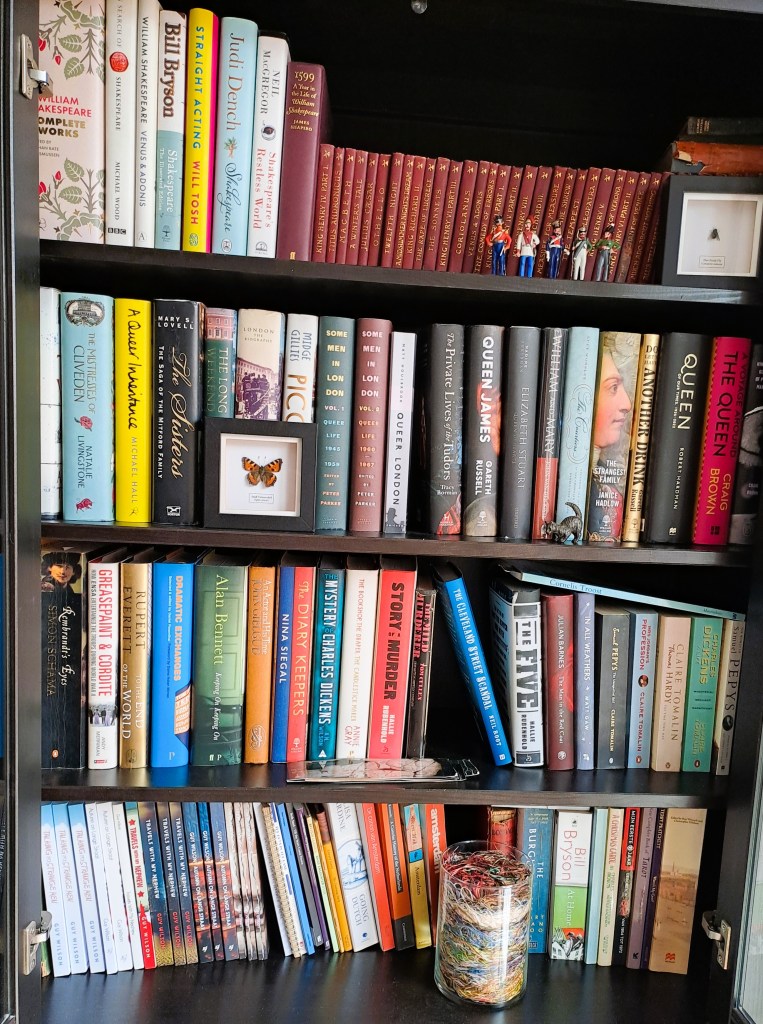
And then I looked at my bookcase: ‘Queer London: Perils and Pleasures in the Sexual Metropolis 1918-1957’, ‘A Queer Inheritance’, ‘Straight Acting: Shakespeare’s Many Queer Lives’, ‘Some Men in London: Queer Life (two volumes covering 1945 to 1967), among others, and it slowly dawned on me. There was no getting away from it. Reading queer lives through a modern lens was an eye‑opener. I mean, I’ve been a drag queen and I’ve been a leather queen, but even then I never saw myself as queer. Now you can enrol in Queer Studies courses at the Universities of, among others, Amsterdam and York.

And now here it is: Queer After Everything, printed at the top of my own site, quiet and unapologetic. I didn’t reclaim it in a single moment. It returned to me slowly – through books, through other people’s courage, through the long work of living. This blog begins, I suppose, with the question of how a word can wound you and still become the one you choose to walk with – and what it means to live a life after that.

These issues possibly only arose as a native English speaker. In my mid-forties I upped sticks and left England for the Netherlands where I had to get used to the perfectly respectable use of the word ‘homo’. But that’s a story that belongs to another corner of this unfolding life.

A Person in Three Notes 

There is a quiet alchemy to sitting at my blending table watching different, distinct elements drop into a vial and slow-bleed into one another until they form a single, complex identity. The architecture of a scent mirrors the architecture of a human soul.

Lately, I’ve been wondering whether the truest framework for understanding people isn’t found in a psychology textbook at all, but in the traditional fragrance pyramid of top notes, heart notes, and base notes. While these terms are technically meant to describe molecular weight and evaporation curves, a person, it turns out, is simply a fragrance in motion. We reveal ourselves in layers. We evaporate, bloom, deepen. We linger. We surprise. We contradict ourselves.

And somehow, all of it blends into a life.

Top notes are how we greet the world, how we enter a room, the first hello – bright, volatile, quick to appear. They are lively but soon evaporate, the part of a person you meet at a party or across a counter. They’re the Persona in Jungian terms: charm, wit, nervous sparkle, the social mask that catches the eye but isn’t built to last. Citrus, aldehydes, mint, green leaves – the “hello, I’m here” energies of the world.  We’ve all known someone who is pure bergamot at a party. They shimmer beautifully, then vanish the moment the room heats up. For many of us in the queer community, our top notes were our first armour. They were the performative shimmers we put on before we were ready, or safe enough, to let anyone taste our deeper truths. They made a beautiful entrance, but they didn’t define the whole story.

Heart notes are how we love. Once the initial sparkle fades, the mid notes emerge – the emotional spine that holds everything together. This is the Ego: the core character, the values, the emotional weather system that shapes how someone moves through a room once the small talk has burned off. Florals, spices, herbs, tea notes – the slow, authentic unfurling of a person’s true self. Heart-note people are warm, relational, textured. Their humour blooms gradually; their steadiness carries the melody for hours. This is the part of a person you build a life with. If the top notes are the greeting, the heart notes are the conversation that makes you stay.

Base notes are how we endure. They are our inner gravity, the parts of us shaped by memory, temperament, childhood, old wounds, and old loyalties. They can get a bit heavy, but they are still much needed to support the rest of the composition. Woods, resins, musks, amber, leather: the deep hum beneath everything else.  Our queer base notes are often dense with history. They hold the sediment of our struggles, the grit of our coming out, the heavy baselines of the families we lost, and the chosen families who anchored us. Base-note people carry intensity, reliability, history. They can overwhelm if experienced entirely alone, but without them, nothing holds. They’re what stays on your scarf the next day – the emotional sediment that refuses to evaporate.

Once you start thinking this way, whole personality types begin to smell familiar:

The Citrus / Bright Cologne (The Optimist): Sparkling, social, refreshing. Joyful in the moment, sometimes restless in the long term.

The Woody / Chypre (The Stoic): Grounded, intellectual, a little reserved at first. Deeply stable once you know them.

The Amber (The Enigma): Warm, emotional, dramatic, unforgettable. A presence that fills the room and lingers.

The Fresh Fougère (The Pragmatist): Clean lines, clear boundaries, structured, dependable. Lavender and oakmoss in human form.

We recognize these people instantly, even without the language of perfumery. I’ve met people who were all top notes, and I’ve loved people who were mostly base, and I’ve spent years learning which of my own notes arrive first.

The Fixative  –  What Makes Us Last

Every perfumer knows that without a fixative, even the most beautiful composition evaporates too quickly. Our human fixative is self-awareness – the thing that allows the bright, fleeting parts of us to linger long enough to matter. It’s what keeps our top notes from burning out, our heart notes from collapsing, and our base notes from overwhelming us. It’s the quiet discipline of noticing ourselves before we spill.  A well-balanced perfume is a kind of emotional equilibrium. It is a tangible reminder that we need the light, the substance, and the gravity – all working together – to become something beautiful that lasts.  And the way those layers interact – harmoniously, chaotically, unexpectedly – is exactly what makes us human. It is what makes us beautifully, resiliently queer after everything. It’s the quiet alchemy of being alive, making each of us a scent story still unfolding.  We are all still blending. 

White Bread – A Small Act of Reclamation

A short meditation on how an ordinary white loaf can become a way of reclaiming the table, the past, and the meanings we outgrow.

Some things appear in a kitchen without ceremony.

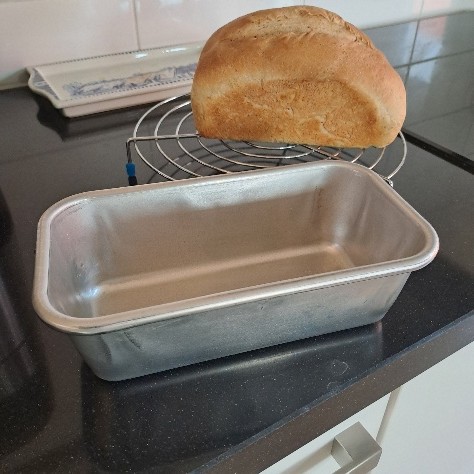
A loaf tin cooling on the counter.

A faint line of flour on the sleeve.

A white loaf — plain, steady — waiting for its moment.

It looks ordinary. But the ordinary is where the deepest histories hide.

Freshly baked bread for lunch is a treat, but it needs planning: the overnight starter, the early rising, the slow choreography of knead, prove, knead, shape, prove again. Domestic labour, yes, but also a way of shaping the day before the day shapes you.

I grew up with this bread.

The white tin loaf was the bread of Daily Mirror households — the bread of terraced kitchens, post‑war prefabs, and back‑to‑back streets where the radio murmured and the world’s scandals were first encountered over tea. It belonged to the people who worked, who made do, who knew their place because the country kept telling them what it was.

To bake it now is to step back into that lineage, not nostalgically but knowingly. Domesticity becomes a kind of quiet authority, a way of reclaiming the spaces that once defined us. A loaf can be a declaration of domesticity as power.

The tools gather their own weather.

The tin — heavy, rectangular — shapes the dough the way a northern town shapes a childhood: firm edges, fixed expectations, heat absorbed and held. The cooling rack raises the loaf, not to display it but to let it breathe. A loaf cools where a life once overheated.

And somewhere between the kneading and the waiting, memory rises.

The kitchen table was the site of my political awakening and my illegal sexuality — the place where class, desire, shame, and possibility all sat elbow‑to‑elbow. Baking a white loaf now is not nostalgia; it is reclamation. A way of saying: this life, this table, this history — mine.

Reclamation has its own rhythm.

Some things once used to diminish us become part of our architecture simply because we’ve lived long enough to outgrow the old meanings. A loaf can do that. So can a word. So can a life.

When the bread slips cleanly from the tin and gives that hollow knock on the base, something settles. Not triumph. Not nostalgia. Something quieter. A recognition that the simplest things can carry the heaviest meanings.

A white loaf, warm from the tin.

A small act of reclamation.

A reminder that the ordinary is never just ordinary.

A simple loaf, after everything.

The Quiet Logic of a Bookcase

A bookcase is never just a bookcase, never just storage. It’s the closest thing most of us ever make to a self‑portrait – an autobiography in wood and paper. Mine has been growing and shedding and rearranging itself for decades, and now, in this quieter phase of life, I’ve realised it has become a kind of doorway. Not into the past exactly, but into the parts of myself that have survived every version of me so far. It’s a record of what has marked me – the obsessions I’ve returned to, the histories I’ve tried to understand, the queer breadcrumbs I followed long before I had the language for myself.

Some books arrived because I needed them. Others stayed because they refused to be forgotten. A few are there simply because they make me feel more like myself when I see them. Together they form a map of a life lived in the margins and footnotes, in the quiet corners of history, in the places where official narratives fray.

Between the books sit the small things that have followed me through life – framed insects, a line of toy soldiers, a jar of embroidery offcut threads – the quiet punctuation marks of a bookcase that has grown with me.

The Shakespeare shelf is a good example. At school I hated him – or perhaps I hated the way he was taught. Years later, I found my own way in, sitting in a dark cinema watching Polanski’s Macbeth, realising that the language I’d dismissed was actually a pulse. Now Shakespeare occupies the top shelf, the one where the porn used to be in English newsagents. The newest arrival is Will Tosh’s Straight Acting, a reminder that queer lives have always been present, even when the archive pretends otherwise. The oldest is an antique set once owned by a Manchester mill owner who wanted a cultured life for his son — a son who died in the First World War, whose own son died in the second. And now those volumes sit here in the Netherlands, in my care for a little while. I hope they find a good home after I’m gone. A bookcase teaches you about stewardship as much as taste.

Other shelves reveal other preoccupations: diaries, letters, the private marks people leave on the past. My working‑class ancestors rarely appear in the record, so I borrowed what I could — the Verneys, the Mitfords, the country houses and the country homos, the scandals and the exiles. These books taught me how to read absence as much as presence. They taught me that history is not just what happened, but what survived, often against the odds.

There are the London books too – Piccadilly, where a fifteen‑year‑old boy in the 1970s could be both invisible and free. There are the monarchs, the misfits, the women pushed to the margins: Dorothy Jordan, mistress of the future William IV, mother of ten illegitimate children, discarded the moment legitimacy became politically inconvenient. Had her eldest son been born on the right side of the blanket, there would never have been a Queen Victoria.

The theatrical shelf sits beside the darkest one: memoirs of actors next to diaries from Nazi‑occupied Netherlands, next to studies of murder victims whose voices are finally being heard. The randomness of survival is a constant theme. Perhaps that’s why the portrait of Dr Samuel Pozzi hangs in our living room – a man caught between eras, between identities, between stories. His biography sits here too, a reminder that lives are rarely tidy.

And then, at the bottom, my own authored books. Not pride of place, but ground level – the foundation rather than the crown. Alongside them, Dutch history, which for an islander like me is harder to hold in one place. Boundaries shift. Water intrudes. Power rearranges itself without the courtesy of a sea to cross.

When I stand back, what I see is not a catalogue but a constellation. A queer life in books. A life shaped by the stories I sought out and the ones that sought me. A life marked by curiosity, by survival, by the quiet insistence on finding myself in the margins when the centre had no room.

This bookcase is not impressive – it is honest. It shows the long, uneven, unglamorous work of becoming. It shows what remains after everything else has fallen away.

It shows, in its own quiet way, how a life is read.

Still Life with Thread and Memory

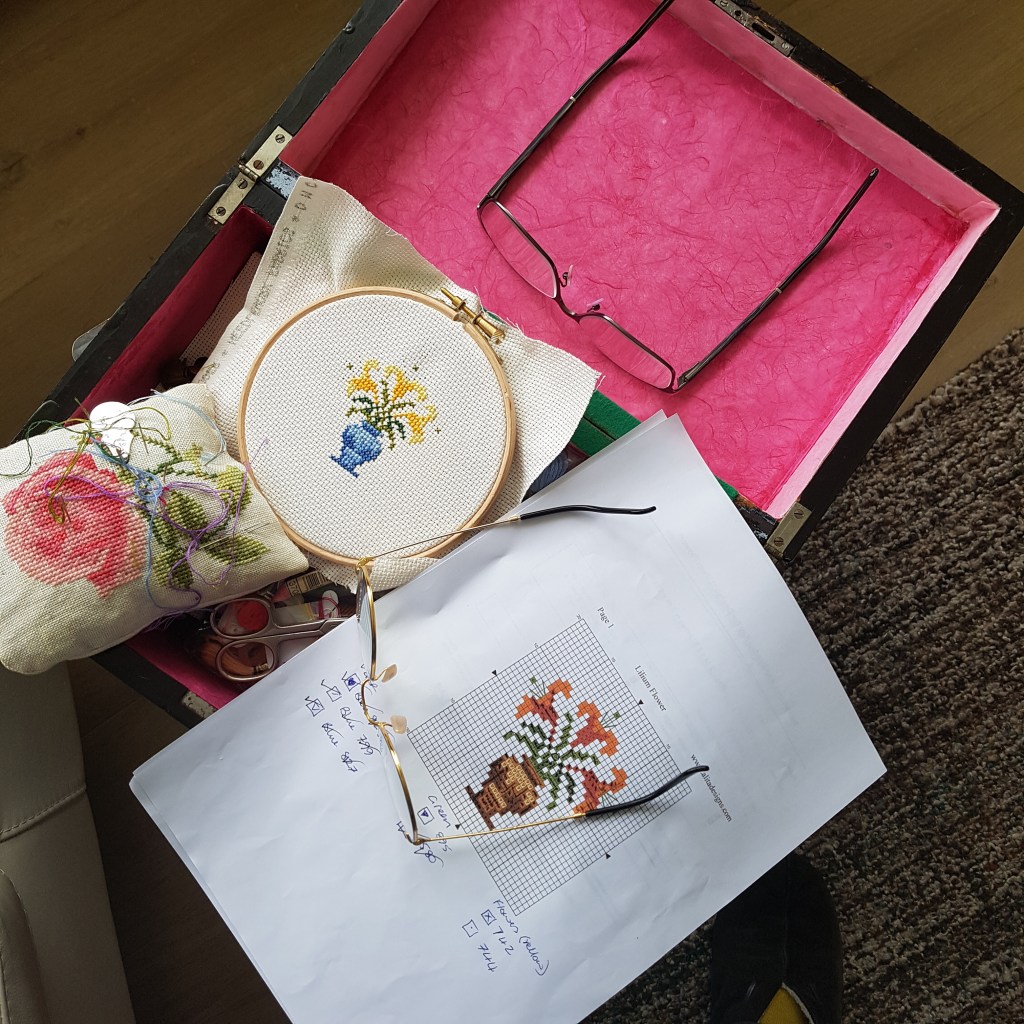
On the table, a workbox opens like a small domestic theatre. A hoop holds a half‑formed vase of blue, the printed pattern waits beside it, and two pairs of glasses rest as if they’ve stepped out of the scene for a moment. Nothing here is finished; everything is in motion.

If revenge is a dish best served cold, then mine has had half a century to chill. I grew up in a school – and a society – determined to press me into a narrow shape. Because I was a boy, I was funnelled into woodwork, metalwork, technical drawing. I was predictably terrible at all of them. What I was good at was attracting homophobic jeers from teachers and pupils alike. But even then, I was stubborn. I insisted on taking cookery, refusing to waste any more timber or scorch any more metal, and quietly preparing for the day when I would no longer be living under my mother’s roof. I needed to know how to feed myself.

Even I knew I couldn’t push things much further than a Victoria sponge. I failed the exam anyway – not for lack of skill, but because I served pork with pears. “You can’t put meat and fruit on the same plate,” the examiner sniffed, until I reminded her about pork and apple sauce. By then I already had a reputation for being “difficult” and “answering back.”

Asking to join the girls for sewing or knitting would have made the local paper. So I taught myself to sew on a button and left it at that.

Decades later, having escaped the small island and lived several lives in the Netherlands, I was recovering from an illness when I wandered down a spring‑speckled Dutch street and stepped into a craft shop. The owner couldn’t have been kinder. A man asking how to begin embroidery – she didn’t blink. She taught. I learned. I brought home threads and fabric and needles and hoops, and with them, the quiet satisfaction of cocking a fifty‑year‑old snoot at those vile teachers.

Embroidery didn’t begin as a craft for me. It began as revenge – and as permission to do something I’d forbidden myself for half a lifetime. Now it has become a way of making a small, steady place to be. A way to occupy the hands when the world feels too loud. A practice that rewards patience rather than speed.

A hoop, a pattern, a pair of glasses, a tangle of threads: the beginnings of a discipline that teaches me how to look, how to slow down, how to stay with something long enough for it to become mine.

Every stitch is a small decision to stay. This is where the peace begins – in the quiet work of making something that didn’t exist before.