A bookcase is never just a bookcase, never just storage. It’s the closest thing most of us ever make to a self‑portrait – an autobiography in wood and paper. Mine has been growing and shedding and rearranging itself for decades, and now, in this quieter phase of life, I’ve realised it has become a kind of doorway. Not into the past exactly, but into the parts of myself that have survived every version of me so far. It’s a record of what has marked me – the obsessions I’ve returned to, the histories I’ve tried to understand, the queer breadcrumbs I followed long before I had the language for myself.
Some books arrived because I needed them. Others stayed because they refused to be forgotten. A few are there simply because they make me feel more like myself when I see them. Together they form a map of a life lived in the margins and footnotes, in the quiet corners of history, in the places where official narratives fray.
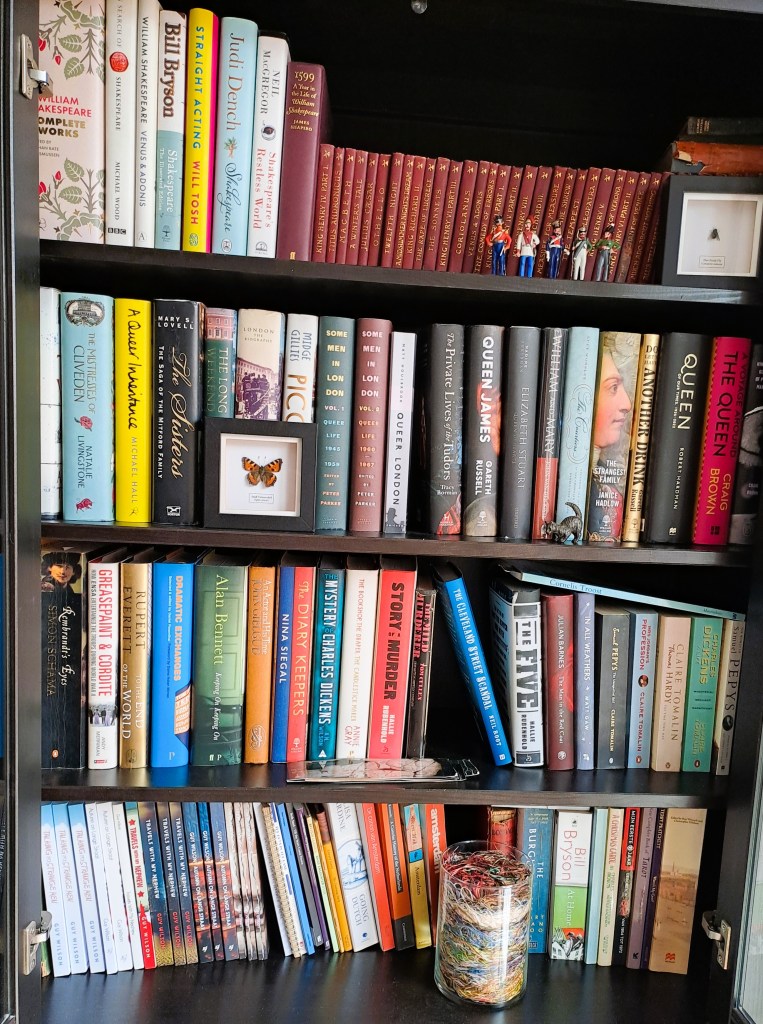
Between the books sit the small things that have followed me through life – framed insects, a line of toy soldiers, a jar of embroidery offcut threads – the quiet punctuation marks of a bookcase that has grown with me.
The Shakespeare shelf is a good example. At school I hated him – or perhaps I hated the way he was taught. Years later, I found my own way in, sitting in a dark cinema watching Polanski’s Macbeth, realising that the language I’d dismissed was actually a pulse. Now Shakespeare occupies the top shelf, the one where the porn used to be in English newsagents. The newest arrival is Will Tosh’s Straight Acting, a reminder that queer lives have always been present, even when the archive pretends otherwise. The oldest is an antique set once owned by a Manchester mill owner who wanted a cultured life for his son — a son who died in the First World War, whose own son died in the second. And now those volumes sit here in the Netherlands, in my care for a little while. I hope they find a good home after I’m gone. A bookcase teaches you about stewardship as much as taste.
Other shelves reveal other preoccupations: diaries, letters, the private marks people leave on the past. My working‑class ancestors rarely appear in the record, so I borrowed what I could — the Verneys, the Mitfords, the country houses and the country homos, the scandals and the exiles. These books taught me how to read absence as much as presence. They taught me that history is not just what happened, but what survived, often against the odds.
There are the London books too – Piccadilly, where a fifteen‑year‑old boy in the 1970s could be both invisible and free. There are the monarchs, the misfits, the women pushed to the margins: Dorothy Jordan, mistress of the future William IV, mother of ten illegitimate children, discarded the moment legitimacy became politically inconvenient. Had her eldest son been born on the right side of the blanket, there would never have been a Queen Victoria.
The theatrical shelf sits beside the darkest one: memoirs of actors next to diaries from Nazi‑occupied Netherlands, next to studies of murder victims whose voices are finally being heard. The randomness of survival is a constant theme. Perhaps that’s why the portrait of Dr Samuel Pozzi hangs in our living room – a man caught between eras, between identities, between stories. His biography sits here too, a reminder that lives are rarely tidy.
And then, at the bottom, my own authored books. Not pride of place, but ground level – the foundation rather than the crown. Alongside them, Dutch history, which for an islander like me is harder to hold in one place. Boundaries shift. Water intrudes. Power rearranges itself without the courtesy of a sea to cross.
When I stand back, what I see is not a catalogue but a constellation. A queer life in books. A life shaped by the stories I sought out and the ones that sought me. A life marked by curiosity, by survival, by the quiet insistence on finding myself in the margins when the centre had no room.
This bookcase is not impressive – it is honest. It shows the long, uneven, unglamorous work of becoming. It shows what remains after everything else has fallen away.
It shows, in its own quiet way, how a life is read.
 Queer After Everything