A short meditation on how an ordinary white loaf can become a way of reclaiming the table, the past, and the meanings we outgrow.
Some things appear in a kitchen without ceremony.
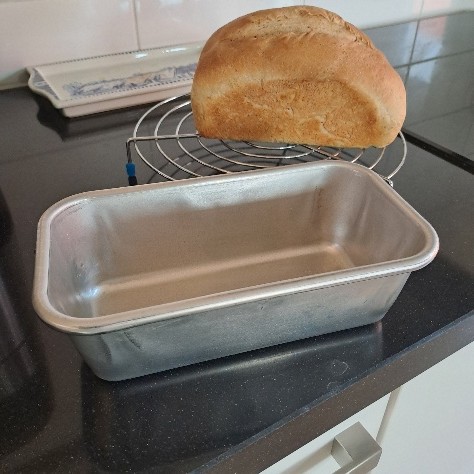
A loaf tin cooling on the counter.
A faint line of flour on the sleeve.
A white loaf — plain, steady — waiting for its moment.
It looks ordinary. But the ordinary is where the deepest histories hide.
Freshly baked bread for lunch is a treat, but it needs planning: the overnight starter, the early rising, the slow choreography of knead, prove, knead, shape, prove again. Domestic labour, yes, but also a way of shaping the day before the day shapes you.
I grew up with this bread.
The white tin loaf was the bread of Daily Mirror households — the bread of terraced kitchens, post‑war prefabs, and back‑to‑back streets where the radio murmured and the world’s scandals were first encountered over tea. It belonged to the people who worked, who made do, who knew their place because the country kept telling them what it was.
To bake it now is to step back into that lineage, not nostalgically but knowingly. Domesticity becomes a kind of quiet authority, a way of reclaiming the spaces that once defined us. A loaf can be a declaration of domesticity as power.
The tools gather their own weather.
The tin — heavy, rectangular — shapes the dough the way a northern town shapes a childhood: firm edges, fixed expectations, heat absorbed and held. The cooling rack raises the loaf, not to display it but to let it breathe. A loaf cools where a life once overheated.
And somewhere between the kneading and the waiting, memory rises.
The kitchen table was the site of my political awakening and my illegal sexuality — the place where class, desire, shame, and possibility all sat elbow‑to‑elbow. Baking a white loaf now is not nostalgia; it is reclamation. A way of saying: this life, this table, this history — mine.
Reclamation has its own rhythm.
Some things once used to diminish us become part of our architecture simply because we’ve lived long enough to outgrow the old meanings. A loaf can do that. So can a word. So can a life.
When the bread slips cleanly from the tin and gives that hollow knock on the base, something settles. Not triumph. Not nostalgia. Something quieter. A recognition that the simplest things can carry the heaviest meanings.
A white loaf, warm from the tin.
A small act of reclamation.
A reminder that the ordinary is never just ordinary.
A simple loaf, after everything.
 Queer After Everything